

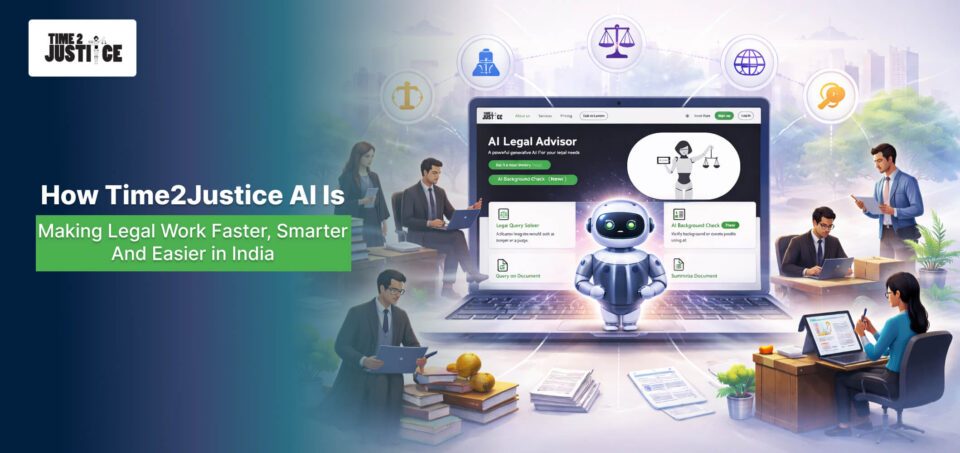
In India, legal work is not simple. A lawyer preparing for a hearing spends hours searching through bare acts, amendments, past cases and judgments. A judge’s research team manually traces precedents across multiple cases. A business owner receives a legal notice and has no idea what it actually means. A law student struggles to understand how a section of law is applied in real cases. An individual trying to know their rights ends up lost in legal jargon and scattered information sources.
This is not because the information doesn’t exist. It exists everywhere, and that is the problem. The Indian legal ecosystem has always had data, but very little accessibility. Laws are published. Judgments are available. Gazettes, notifications, circulars, and amendments are all public. Yet finding the right piece of information at the right time often feels like searching for a needle in a haystack.
For decades, this has been accepted as “how legal work is done.” Until someone asked a simple question:
Why is legal work still so hard when AI makes everything else easy? Time2Justice is here to change that.
This is where Time2Justice enters the picture; it is not any other legal website, but a solution to a deep, long-standing problem in how legal information is accessed, understood and used in India. We don’t just offer tools; we make the entire justice process smoother, faster and accessible to everyone. This is a story about fixing friction in the justice ecosystem.
The Real Problem No One Talks About
Legal professionals do not suffer from a lack of knowledge. They suffer from a lack of time.
Endless searches to pinpoint the right legal provision.
Information overload: Reading hundreds of pages for a tiny fraction of insight.
Repetitive labour in creating standard drafts from scratch.
Pre-case friction: Trying to understand unstructured client documents.
Manual due diligence for people and record verification.
Client education bottlenecks: Answering the same fundamental questions over and over.
Every day, thousands of lawyers, judges, students, businesses and ordinary citizens spend excessive time going through scattered legal information. They jump between bare acts, judgments, notifications, documents and multiple websites just to find what they need. This constant switching slows down case preparation, delays decision-making, increases legal costs and creates frustration across the system. The issue is not that the law is too complex to understand, but that the information required to apply it is spread across disconnected sources. Time2Justice was built on the idea that if legal data could be brought together intelligently in one place, legal work would become faster, clearer and far more efficient.
How Time2Justice Helps Lawyers Prepare for a Case
A criminal lawyer preparing for a bail hearing often spends hours searching IPC/BNS sections, reading multiple High Court and Supreme Court bail judgments and understanding how judges interpreted the law in similar situations. They must draft arguments from precedents and recheck amendments. This traditional legal research process can easily consume an entire day before the actual hearing begins.
With Time2Justice, the lawyer can instantly search the exact legal section, access related bail judgments, and see how courts applied the law in real cases. Instead of browsing multiple websites and PDFs, all relevant legal information appears in one place, structured and searchable, saving valuable preparation time before court.
The lawyer can then use AI-assisted drafting to prepare arguments based on real precedents and verified references. What was once slow, manual legal research becomes fast, organised, and intelligent case preparation, allowing the lawyer to focus more on strategy, argument quality, and courtroom presentation rather than document research.
How AI-Driven Legal Technology Helps Business Owners Understand Legal Notices Without Panic
A small business owner receiving a legal notice often feels confused by complex legal language and unclear implications. Before even contacting a lawyer, they struggle to understand what the notice actually says, which laws are involved, and how serious the matter is. This uncertainty creates panic, delays response, and increases unnecessary legal expenses.
With Time2Justice, the business owner can upload the legal notice and receive a simplified explanation in plain language. The platform highlights the relevant legal sections, explains the context, and helps the user clearly understand the issue without needing immediate professional intervention or extensive legal reading. They can also draft a preliminary reply using an Artificial Intelligence (AI) assistance tool, and then approach a lawyer with clarity and preparation. This reduces anxiety, saves time and ensures that the first legal consultation is focused, informed, and far more productive for both the business owner and the lawyer.
How AI Helps Judges’ Research Teams Find Relevant Precedents Faster
Judges depend on well-researched precedents, and their research teams often spend long hours going through volumes of past judgments to understand how courts ruled in similar matters. This process involves manual searching, reading lengthy case files, and cross-checking related legal sections before useful references can be identified for judicial consideration.
With Time2Justice, research teams can search judgments contextually rather than relying only on keywords. They can quickly discover how specific laws were interpreted across different cases, access related judgments, and view relevant legal sections and amendments together in one structured search environment, reducing scattered research efforts.
This approach allows research teams to spend less time hunting for documents and more time focusing on legal interpretation, reasoning, and supporting the judge with precise, well-connected precedents that strengthen the quality and depth of judicial decision-making.
Time2Justice AI Helps Law Students Connect Bare Acts with Real Case Law
Law students often read bare acts repeatedly but struggle to understand how those sections are applied in real court cases. The gap between theoretical law and practical interpretation makes studying difficult, as students cannot easily see how judges use these laws in actual legal situations and judgments.
With Time2Justice, a student can search for any section of law and instantly find judgments where that section was applied. They can explore how courts interpreted the provision, ask AI questions about its meaning, and understand the practical context behind the legal text they are studying. This transforms legal study from passive reading into active exploration. Instead of memorising sections, students begin to understand how laws function in real cases, improving their comprehension, analytical skills and readiness for future legal practice.
How Time2Justice Features Solve Real Legal Problems for Lawyers, Businesses, Students and Individuals
Legal Query Solution: Get Clear Legal Answers Backed by Laws and Judgments
Many people turn to random websites or forums when they have a legal question, often ending up more confused than before. Legal language is complex, and finding answers that are accurate, relevant, and based on Indian laws and judgments is difficult. Time2Justice’s Legal Query Solver allows users to ask direct legal questions in simple language and receive structured answers supported by real legal provisions and case law. This helps lawyers, students, businesses, and individuals quickly understand legal positions without hours of research. It works like an intelligent legal assistant that connects questions with the right sections, judgments, and explanations in one place.
Draft Document Assistance: Create Legal Documents Faster and Smarter
Drafting legal documents like agreements, replies to notices, contracts, or legal letters usually starts from a blank page. This takes time, effort, and repeated reference to legal formats. Time2Justice’s Draft Document Assistance helps users generate structured legal drafts using AI support based on standard legal practices. Lawyers can speed up routine drafting, businesses can prepare compliant documents, and individuals can create basic legal replies and rental agreements confidently. Instead of struggling with format and wording, users can focus on the content and intent. This feature reduces drafting time, improves accuracy, and makes legal documentation easier for everyone involved.
Background Verification: Reduce Legal Risk Before It Becomes a Problem
Before hiring an employee, renting property, or entering into a partnership, verifying the background of a person or company is critical. Manual verification is slow and often incomplete. Time2Justice’s Background Verification feature helps users check essential details and identify potential legal or credibility risks early. Businesses can verify candidates and vendors, landlords can verify tenants, and individuals can check who they are dealing with. This proactive step reduces the chances of fraud, disputes, and legal trouble later. Legal safety often starts before an agreement is signed, and this feature supports informed decision-making with reliable insights.
Large Base of Lawyers: Connect with the Right Legal Expert or Register Yourself
After understanding a legal issue, the next challenge is finding the right lawyer. Many people rely on referrals or random searches, which may not lead to the most suitable legal expert. Time2Justice provides access to a large base of lawyers categorised by expertise, customer ratings and location. Users can identify lawyers who match their specific legal needs, making the process easier and more targeted. If you are a lawyer, you can also register yourself on the platform to increase visibility and connect with relevant clients actively seeking legal assistance.
Why Time2Justice.AI Is Better Than General AI Tools
Time2Justice is designed specifically for Indian legal use, which makes it very different from general AI tools like ChatGPT or other random platforms. While generic AI can provide broad explanations, it does not have structured access to Indian bare acts, sections, judgments, gazettes, notifications, and legal databases in an organized legal research format. Time2Justice connects AI directly with verified legal sources and searchable legal records, giving answers that are contextually linked to real laws and case precedents. It is built for legal research, document drafting, verification, and lawyer discovery in one place. Instead of general knowledge, users get legally relevant, practical, and research-ready outputs tailored for real legal work.
Why Time2Justice Matters to the Entire Legal Ecosystem
When legal research becomes faster and more organised, the overall quality of case preparation improves. Lawyers spend less time searching and more time building strong arguments. Judges and their research teams can rely on richer, well-connected precedents. Court time is used more effectively because arguments are supported by precise legal references rather than scattered material collected from multiple sources. This efficiency does not just benefit professionals inside the courtroom, but everyone connected to the legal process.
When individuals clearly understand their legal position, they approach lawyers with better clarity and realistic expectations. Businesses that manage legal workflows efficiently face fewer compliance issues and disputes. Law students who study laws alongside real case applications develop a deeper legal understanding. Time2Justice contributes to a system where legal information is easier to access, interpret, and apply. This is not merely about productivity. It is about improving how justice is researched, prepared, and delivered across the ecosystem.
The People Behind Time2Justice: Neeraj Gutgutia and Prateek Agrawal
Time2Justice was founded by two professionals who understood both the practical challenges of the legal system and the power of technology to solve them.
Neeraj Gutgutia, co-founder of Time2Justice, comes from a strong background in business, finance, and governance. As a Chartered Accountant with management education from IIM Indore, he has worked with large organizations and has long experience in building technology platforms that serve public systems. He is also the founder of Right2Vote, a well-known eVoting platform. Right2Vote is STQC, MCA and ISO 27001 certified, meaning it meets the highest security and compliance standards. Through his work, he closely observed how legal, compliance, and verification processes were slow, manual, and difficult for people to navigate.
Prateek Agrawal, co-founder and technology head, brings deep expertise in artificial intelligence, data systems, and large-scale technology solutions. With many years of experience in AI and consulting, he has worked on complex technology problems and trained thousands of professionals in advanced technologies. He understood how AI could be applied to organize legal information in a smarter way.
Together, they built Time2Justice with a simple goal: make legal information easier to access, understand, and use for everyone.
Who Benefits Most from Time2Justice
For lawyers and judges, Time2Justice enables faster legal research, stronger case preparation, and better judgment insights supported by relevant precedents. It reduces the manual effort involved in finding sections, judgments, and legal references. For law students, it bridges the gap between theoretical learning and practical case application, helping them understand how laws work in real court situations rather than only in textbooks.
For businesses, it simplifies compliance, speeds up contract drafting, improves legal workflows, and reduces the risk of legal surprises. For individuals, it brings clarity about their rights, helps them understand legal documents, and guides them toward the right lawyer when needed. The justice system does not function on courts alone. It depends on how easily people can access, understand, and use legal information. Time2Justice works to close this gap across India.
