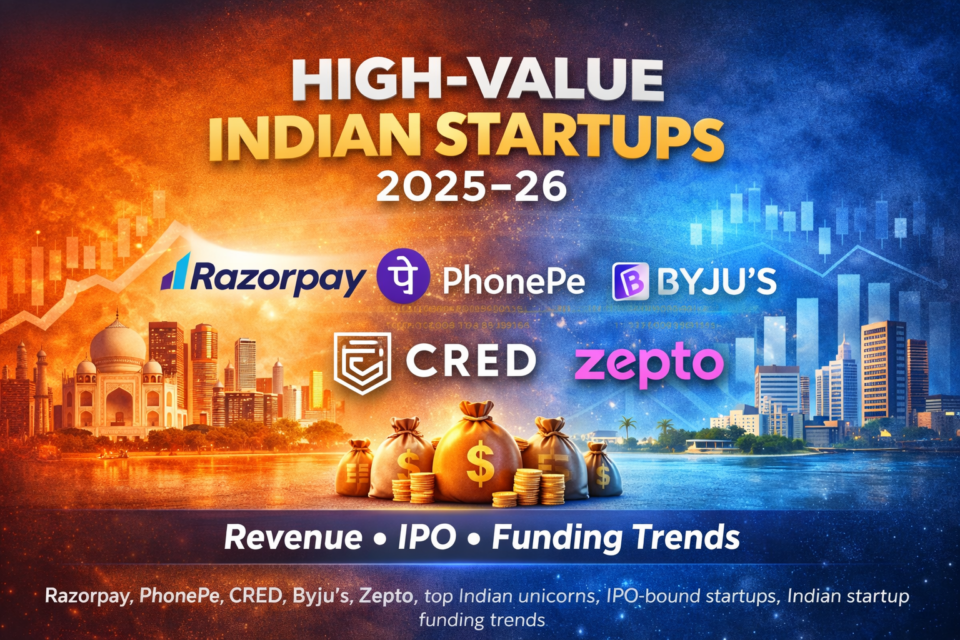
India’s startup ecosystem entered 2025–26 with an unusual mix of momentum and reality-checks: blockbuster private valuations, big liquidity events headed for public markets, stronger unit economics at some firms and high-profile governance and legal troubles at others. Below is a concise, journalist-style tour of the highest-value and most consequential Indian startups this year, what they earned or were valued at, and the macro trends investors and founders are watching.
1) Razorpay — payments powerhouse in IPO prep
Why it matters: Razorpay remains India’s marquee payments fintech, scaling rapidly across merchant payments, payouts and enterprise banking products. The company’s post-money private valuation was reported at about $9.2 billion in mid-2025 and it has been publicly linked to IPO plans and large capital raises as it moves toward listing.
What to watch: Razorpay’s path to profitability, regulatory shifts in digital payments, and the pricing/timing of any IPO will be key signals for the fintech market and for investor appetite toward large Indian tech IPOs.
2) PhonePe — scaling toward a giant public listing
Why it matters: PhonePe is preparing for a major IPO in 2026 and has filed updated papers that suggest a target valuation in the neighborhood of $15 billion for the offering. The company dominates a large share of UPI volume and is a top contender for the largest India tech IPOs of 2026.
What to watch: PhonePe’s IPO structure (largely an offer-for-sale), progress on narrowing losses, and investor appetite for large, growth-at-scale fintechs.
3) CRED — big revenue, narrowing losses
Why it matters: CRED continued to scale revenue in FY25 while trimming losses a sign that monetisation efforts are yielding results. The company reported sizable FY25 revenues and materially lower operating losses versus prior year, which positions it as a high-value fintech trying to convert scale into sustainable profitability.
What to watch: Product diversification (credit products, wealth, B2B offerings), margin improvement, and whether CRED can sustain revenue growth without outsized marketing spend.
4) Byju’s — once-dominant, now a cautionary case
Why it matters: Byju’s the company that once ranked as India’s most-valuable edtech startup — has faced serious legal and financial setbacks through 2024–25, including court rulings and insolvency proceedings. Recent legal developments have major implications for governance standards and investor protection in the Indian startup ecosystem.
What to watch: Outcomes of ongoing legal proceedings, recovery or restructuring plans, and how investors and founders adjust governance expectations after Byju’s turmoil.
5) Foodtech & travel giants: Zomato and Swiggy — scale + path to profit
Why they matter: Both companies are among India’s highest-profile consumer tech names. Zomato is a public company that has demonstrated the sector’s ability to scale revenues and improve unit economics; Swiggy has continued to expand product lines (groceries, instamart, logistics) and to tighten losses. These firms helped define investor expectations for foodtech unit economics. (sector context no single valuation cited here; see company filings for precise market caps / private valuations.)
What to watch: Food delivery break-even by unit and geography, profitability from adjacent services (instacart/grocery, cloud kitchens), and margin improvement.
6) D2C & quick commerce names: Zepto, Meesho, and D2C challengers
Why they matter: Quick commerce and D2C brands captured large private capital pools in prior years. Some firms doubled down on path-to-profit playbooks; others saw valuation resets. The segment remains capital-intensive but crucial for FMCG and retail distribution innovation.
What to watch: Cash burn per order, retention & repeat rates, and consolidation / M&A among smaller D2C players.
7) Fintech & wealth platforms: Groww, Zerodha (market leaders)
Why they matter: Wealthtech and retail brokerage firms continued to grow transaction volumes and revenues as India’s retail participation in capital markets expanded. Some firms prepared secondary liquidity events or public listings, which lifts valuations across the sector.
What to watch: Revenue diversification (mutual funds, direct equities, subscription), regulatory changes affecting broking margining, and IPO/secondary windows.
Macro trends shaping 2025–26 valuations
- IPO wave & public comparables. Several large startups (or soon-to-be-public firms) notably PhonePe and Razorpay are moving toward listings. Successful public debuts can re-rate private valuations and unlock liquidity for founders & early backers.
- Profitability and unit economics matter more. Investors are shifting from “growth at any cost” to disciplined growth: margin improvement, lower cash burn and path-to-profit are frequently required by new rounds or IPO prospectuses.
- Regulation is a growing risk and catalyst. Payments regulation, digital lending rules, and corporate governance scrutiny (highlighted by high-profile cases) are changing how investors price risk. The Byju’s saga is a reminder that governance failures can erase value fast.
- Consolidation in crowded categories. Quick commerce, D2C fashion and some fintech verticals are seeing M&A, larger players acquiring talent/tech rather than competing solely on cash burn.
- The unicorn club remains large but recalibrated. India’s count of unicorns kept rising into 2025, but headline valuations are now judged against profitability and realistic IPO comparables. Industry trackers reported well over 100 Indian unicorns in recent months, underscoring scale but also the need for differentiation.
What investors and founders should be watching now
- Credibility of public filings and governance: investors are reading prospectuses and RoC filings more carefully; governance lapses can have outsized consequences.
- Capital efficiency over chase for market share: companies that show improving unit economics attract better late-stage terms.
- Timing of IPOs and secondary windows: Razorpay and PhonePe are the names most likely to reshape public perception of India tech with large IPOs.
- Regulatory clarity in payments and lending: policy moves will materially affect business models and valuations in fintech.