
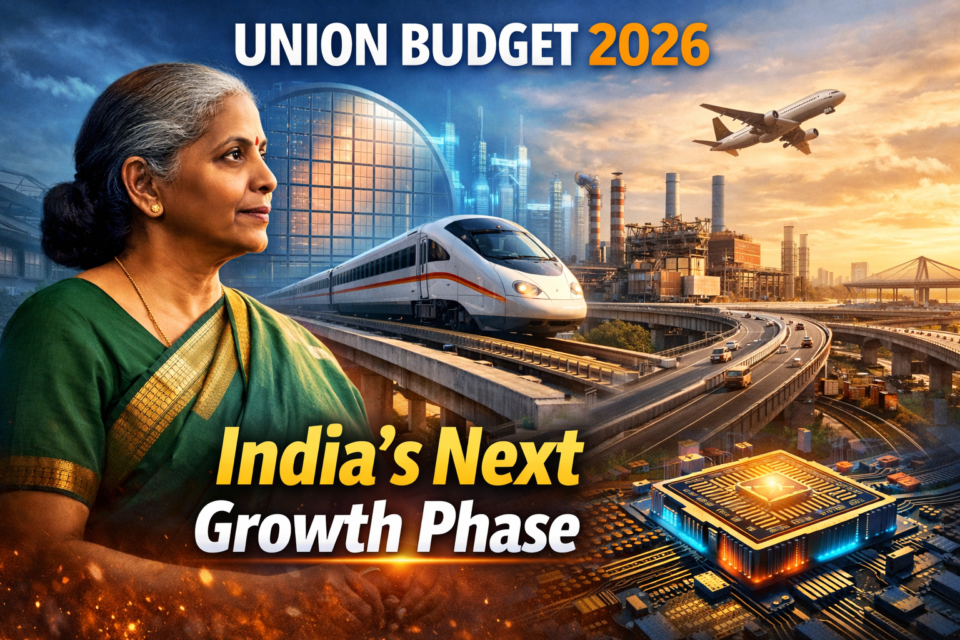
NEW DELHI: The Union Budget https://theindiabizz.com/?s=Union+Budget2026–27, presented by Finance Minister Nirmala Sitharaman, lays out a clear and disciplined economic roadmap as India moves closer to its long-term goal of Viksit Bharat 2047. Anchored in infrastructure-led growth, manufacturing expansion, technology adoption, and fiscal stability, the Budget underscores continuity in policy rather than short-term populist measures.
Instead of broad giveaways, Budget 2026 prioritises capital formation, productivity enhancement, and strategic sector development, reinforcing India’s ambition to emerge as a resilient and globally competitive economy amid uncertain international conditions.
Infrastructure Remains the Growth Engine
Infrastructure once again takes centre stage in Budget 2026, with the government significantly ramping up capital expenditure (capex) to stimulate economic activity, create jobs, and improve efficiency across supply chains.
Key infrastructure announcements include:
- Development of seven new high-speed rail corridors connecting major industrial and economic regions
- Continued expansion of national highways, ports, and inland waterways
- Accelerated development of multimodal logistics parks to reduce transportation costs and improve last-mile connectivity
The government believes that sustained investment in physical infrastructure will not only crowd in private investment but also enhance India’s competitiveness by lowering logistics costs and enabling faster movement of goods and services.
Manufacturing and Technology Get a Strong Push
Building on the momentum of Make in India and Atmanirbhar Bharat, Budget 2026 places renewed emphasis on strengthening domestic manufacturing and emerging technologies.
Among the key initiatives announced:
- Launch of India Semiconductor Mission 2.0, covering chip design, fabrication, packaging, and materials
- Fresh and extended incentives for electronics, defence manufacturing, chemicals, and textiles
- Policy support for artificial intelligence (AI), animation, gaming, and creative industries, aimed at unlocking new-age employment opportunities
By deepening domestic manufacturing capabilities, the government aims to reduce import dependence, secure critical supply chains, and position India as a reliable global manufacturing and innovation hub.
Focus on Jobs and Skill Creation
While not framed as direct employment schemes, the Budget’s emphasis on infrastructure, manufacturing, and digital industries is expected to generate large-scale employment, particularly for youth and semi-skilled workers. Investments in high-growth sectors are also likely to spur demand for specialised skills, aligning workforce development with future industry needs.
Fiscal Discipline and Investor Confidence
A key highlight of Budget 2026 is the government’s continued commitment to fiscal consolidation. By maintaining controlled borrowing and prioritising efficient expenditure, the Budget seeks to strike a balance between growth and macroeconomic stability.
Officials stressed that keeping inflation in check and adhering to medium-term fiscal targets would help maintain investor confidence, especially at a time when global capital flows remain volatile due to geopolitical tensions and shifting monetary policies.
Continuity Over Disruption
Notably, the Budget avoids major changes to personal income tax and GST structures, signalling policy stability for households and businesses. This continuity is intended to provide predictability to investors and entrepreneurs, allowing them to plan long-term investments without regulatory uncertainty.
The Bigger Picture
Union Budget 2026–27 reflects a broader strategic vision one that prioritises long-term economic strength over short-term political gains. By doubling down on infrastructure, manufacturing, and technology while maintaining fiscal discipline, the government aims to lay the foundation for sustained growth over the next two decades.
As India advances toward its Viksit Bharat 2047 goal, the success of this Budget will ultimately be measured by how effectively these investments translate into higher productivity, quality jobs, and inclusive development across regions.

India to Gain From ‘Ripple Effects’ of Union Budget 2026 Measures: FM Sitharaman