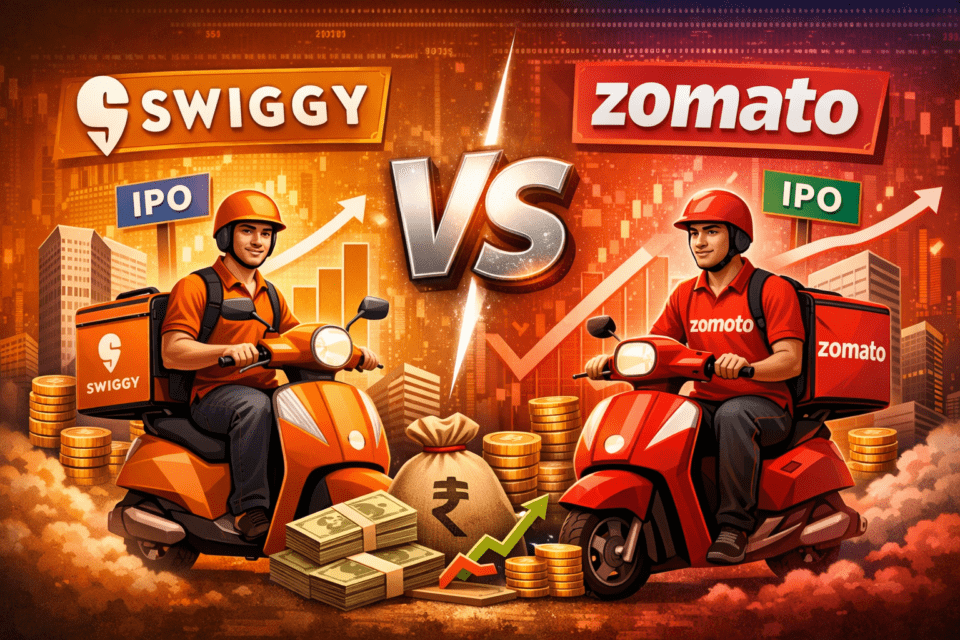
India’s online food delivery market is one of the fastest-growing consumer internet sectors in the world, driven by smartphone penetration, digital payments and changing consumer habits. At the centre of this fierce competition are Swiggy and Eternal Limited (better known by its flagship brand Zomato), two companies that have defined how Indians order food and groceries online.
Both firms have expanded far beyond food delivery into quick commerce, restaurant services and technology-driven lifestyle offerings. Yet their financial trajectories, investor backing and market positions show distinct strategic differences.
Market Position and Business Models
Swiggy, founded in 2014 by Sriharsha Majety, Nandan Reddy and Rahul Jaimini, began as an on-demand food delivery platform from Bengaluru and quickly expanded into multiple “super app” services. Today, it operates food delivery across more than 700 Indian cities and has diversified into:
- Instamart: quick commerce grocery delivery
- Swiggy Genie/Go: delivery of parcels, errands and non-food items
- Dineout: restaurant reservations and offers
- Swiggy One: loyalty and membership program
Swiggy’s emphasis on everyday convenience and on-demand services supports a broad user base, though this has come with high operational costs.
Zomato, launched in 2008 by Deepinder Goyal and Pankaj Chaddah, started as a restaurant discovery platform and pivoted into food delivery, becoming a household name across India and select international markets. Zomato’s ecosystem includes:
- Food delivery
- Restaurant listings and reviews
- Blinkit: quick commerce grocery delivery
- District: dining, events and entertainment services
Zomato’s strategy integrates restaurant services with lifestyle and on-demand delivery, maintaining a strong foothold in urban markets.
Revenue and Financial Performance
According to industry estimates for FY25, Zomato’s annual revenue was significantly higher than Swiggy’s, reflecting both scale and diversified monetisation:
- Zomato: ~₹20,243 crore in revenue, with profit reported at ₹527 crore, marking strong growth and improved profitability.
- Swiggy: ~₹15,227 crore in revenue, but continued net losses (~₹3,117 crore), highlighting challenges in cost control amid rapid expansion.
Swiggy’s more recent quarterly results for Q3 FY26 show a 54% jump in revenue to ₹6,148 crore, though losses widened due to investments in its Instamart quick-commerce business.
Analysts also note that Zomato’s food delivery business has achieved positive EBITDA margins, giving it a stronger position on unit economics compared with Swiggy’s still-improving performance.
IPO and Public Market Journey
A major differentiator between the two companies is their IPO status.
- Zomato went public in July 2021, listing on the Indian stock exchanges (BSE & NSE) with a valuation of around $12 billion. It became one of the most significant Indian tech IPOs of that year, backed by heavy investment from global firms and supported by Info Edge, which later reported its stakes in Zomato and Policybazaar valued at over ₹31,500 crore.
- Swiggy remained unlisted for a longer period, raising funds privately from marquee global investors including Prosus, SoftBank, Accel, Naspers and Invesco.
In November 2024, Swiggy launched its IPO with an issue size of around ₹11,327 crore and a price range between ₹371–₹390 per share, valuing the company at roughly $11.3 billion upon its debut.
The Swiggy IPO marked a major milestone as India’s second large consumer tech listing in the food delivery space, closely following Zomato’s public offering.
Funding and Investors
Swiggy’s funding history reflects strong backing by international investors:
- Early investments from Accel, SAIF Partners, Bessemer and Norwest Ventures
- Major rounds with Naspers, SoftBank and Prosus, including a $700 million funding led by Invesco in 2022 that raised its private valuation to around $10.7 billion before the IPO.
Zomato’s investor base has also been robust, with early backing from Info Edge, Temasek, Tiger Global and other global institutions, underpinning its growth and public market success.
Competitive Strategies and Future Outlook
While both players compete fiercely in food delivery, they have taken strategic paths to future growth:
- Swiggy pushes hard into quick commerce via Instamart, logistics and multi-vertical services, supported by recent capital raises and potential further fundraising through institutional placements.
- Zomato continues to expand with acquisitions like Blinkit and its pivot into lifestyle services like District, deepening its ecosystem.
The competitive landscape also includes other quick commerce players like Zepto, which have raised significant funding and captured market share in the 10-minute delivery segment, intensifying rivalry.