
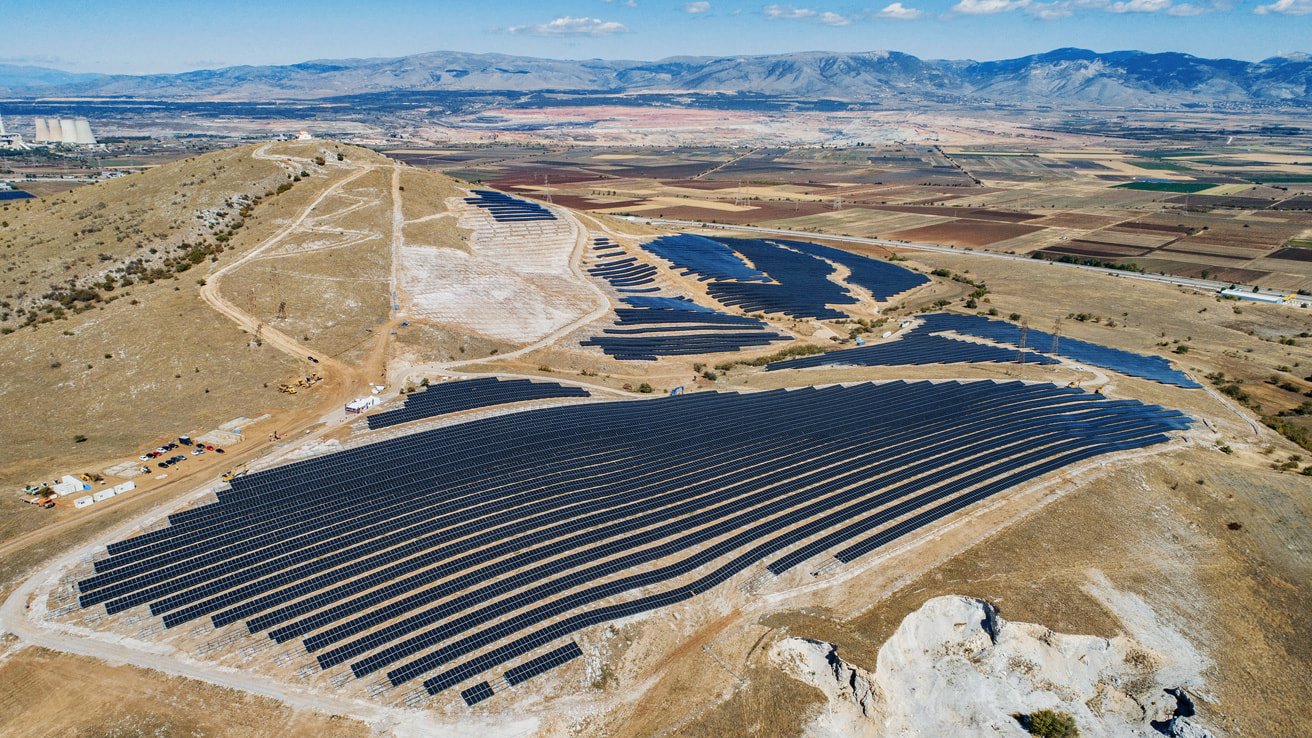
Apple announced Tuesday that it had signed contracts for 650 megawatts of renewable power in Europe.
This includes wind and solar projects that are either operational or will be soon. A large chunk of the power they’ll produce will go toward offsetting the energy used by Apple customers. Use of everything from Mac Pros to Apple Watches accounts for nearly one-third of the company’s carbon footprint.
Even though Europe isn’t usually considered a sunny continent, Apple is buying energy from several solar farms, including 110 megawatts each in Greece and Latvia, 131 megawatts in Spain, and 40 megawatts in Poland. Wind farms will contribute 99 megawatts in Romania and a portion of the 129 megawatt solar-wind portfolio in Italy.
Separately, Apple also said it would invest $150 million in China to help its suppliers switch to renewable energy. Already, renewable sources power more than 90% of the company’s manufacturing and production in the country.
Perhaps most notable about these announcements is that they appear in the newsrooms of Apple’s regional websites, but not in the feed of its U.S. press site. Previously, the company’s press releases on regional renewable power purchases have appeared in that feed, perhaps out of a desire to not draw the ire of the Trump administration, which has been antagonistic to renewables.
Still, solar and wind — and increasingly grid-scale batteries — have been the go-to source of energy for tech companies looking to power their operations.
Microsoft and Meta have also been consistent buyers of solar in particular. This year alone, Meta has added over 2 gigawatts of solar capacity, and Microsoft has signed deals that raise its total by 1.5 gigawatts.
While most big tech firms have pledged to move to renewable power, more practical considerations help drive such deals. Solar and wind are among the cheapest forms of new generating capacity, undercutting coal and natural gas. When paired with batteries, which continue to drop in cost, they can provide firm, 24/7 power.
The other reason is speed: Solar farms can be built quickly, with a typical project requiring just 18 months to complete. What’s more, they can be completed in phases, allowing part of the project to come online early. For tech companies, which are in a race to secure power for their data centers and AI operations, that speed can make a significant difference.

Desk
Verified JournalistDiscover the latest startup, business, and funding news. Get insights on trends, IPOs, mergers, and acquisitions. Perfect for entrepreneurs, investors.
