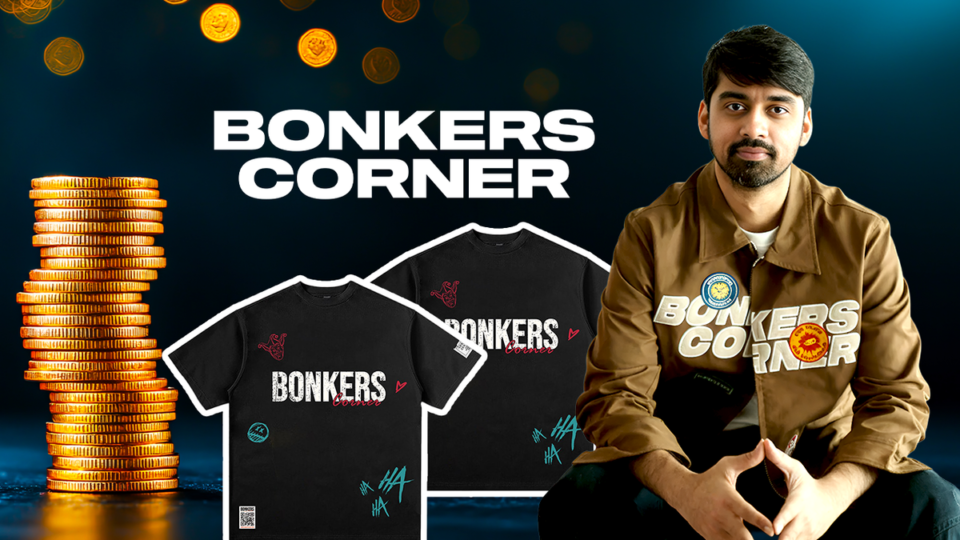
The brand operates in India’s increasingly crowded affordable streetwear market, offering oversized fits, graphic-heavy designs, and comfort-first basics. It competes with players like Bewakoof, The Souled Store, and Urban Monkey.
Oversize apparel was trending globally when the pandemic struck the world in 2020. Indian brands, however, refused to pick up the trend. Gupta started with basic products, making mockups, and promoting them on Instagram through ads to generate orders, until he pivoted to oversized T-shirts for women and gradually widened the basket to a unisex portfolio.
“I didn’t fully realise it, but the timing worked in our favour. No one was doing this. Most of the T-shirts available in the market lacked quality and strong design. From day one itself, we focussed on design and quality to create space for Bonkers.”
The D2C brand got a boost after it appeared on Shark Tank India Season 5, where Namita Thapar of Emcure Pharmaceuticals committed ₹1.5 Cr in investment. Bonkers cornered $15 Mn from its Series A round, led by India SME Investments along with participation from Atul Ruia-led Phoenix Family Office, in March 2026.
Bootstrapped until the first round, the brand remained profitable since its debut. Backed by a steady growth in business, Bonkers bespoke into the retail space in 2023. Three years on, it counts 40% of its business coming from the retail wing.
“Since we were making profits, we did not think of raising external capital. But, as retail was doing well, we needed money to push our offline expansion. A single store takes up to ₹3 Cr to set up,” Gupta said.
The Building Blocks Of Streetwear
In 2011, Gupta dropped out of college after his family’s textile printing business suffered strains.
He stepped in and started figuring out the fundamentals of textile printing — from strain printing processes to how chemicals behave, and what could go wrong in production. By 2013, he decided to move into garment manufacturing.
“While I always wanted to build my own brand, I knew that I lacked the experience. Manufacturing felt like the right place to start,” Gupta said.
That phase gave him a front-row seat to India’s booming D2C theatre. He observed how online-first brands scaled, operated, and evolved once funding came into the picture. “When funding comes in, the brand changes. I didn’t feel I could build long-term relationships in that setup.”
The turning point came during the 2020 lockdowns. Manufacturing slowed, payments became uncertain, and it forced a decision: keep depending on other brands or build something of your own.
Gupta spotted a clear gap. While oversized streetwear was already a global phenomenon, part of a market estimated at over $371 Bn in 2025, but in India, the category was still nascent, fragmented, and largely untapped.
Bonkers Corner zeroed in on this. “It was trending a lot globally. So, we started oversize apparel with a few SKUs in women-focussed tees. Once traction from DM increased, we launched our own website in 2020. By the time we closed our first full fiscal in FY21, we were standing at an INR 5 Cr revenue,” said Gupta.
Venturing Beyond The Core
By the time Bonkers turned two, Gupta realised that the category was naturally unisex. The realisation was affirmed by a notable traction from male buyers. “Male models were hired,” he said.
“This shift also helped us optimise inventory. Instead of managing separate stock for men and women, a single inventory could serve both the segments, no matter if the split was 70-30 or 50-50. This helped us get rid of any dead stock at all. While most brands typically see 5–10% inventory write-offs, we haven’t had to write off any products.”
The brand’s unisex streetwear portfolio today spans across 12,000 SKUs in categories such as oversized apparel, gym wear, joggers, hoodies and sweatshirts.
Expanding beyond the core, Bonkers also leaned into licensed collaborations early on with brands such as Disney, Smiley, Playboy, Tokidoki, and Hot Wheels. These collaborations now make up 15% of its revenue.
Its first physical event was Comic Con, a pop-culture event where people gather to celebrate comics, movies, television, gaming, anime, and more. This came as a shot in the arm for the offline segment, while the online foundation kept gathering strength.
That’s when Bonkers decided to approach Phoenix Mall to set up their first physical store. It was launched in September 2023.
What Paid Off For Bonkers Corner
From online to offline expansion and focus on vertical penetration, Bonkers has established a few concrete strategies.
Mastering The Basics: Gupta counts his technical experience and knowledge as the competitive edge of the brand. After spending nine years in production, he claims that Bonkers is directly involved in every stage of manufacturing the product – from sourcing of material to supply chain.
“There’s a clear difference between us and many other brands because I come from a technical background, having spent nearly nine years in production. I understand everything from sourcing and pricing to garment construction, so there’s no scope for inefficiencies or being misled. Many founders rely on intermediaries for these decisions, which raises costs and reduces quality,” he added.
Cost Discipline At Core: The company always kept a tighter leash on expenses. Gupta stressed that the brand has stayed focussed on certain basics like this since day one, while keeping its team size and overheads largely unchanged.
He claims that even today, the company maintains a lean structure, with controlled overheads despite rising revenue.
Quality Machinery And In-House Production: Bonkers chose to work directly with vendors, instead of relying on intermediaries.
The company claims to be handling everything in-house. It runs three manufacturing sites. Its printing machinery is bought from Portugal and stitching and embroidery machines from Japan, while its raw materials are domestically sourced, including yarn from Vardhaman, with inks imported from Japan.
The D2C fashion industry, according to Gupta, struggles with lack of transparency as a lot of brands do not know much about sourcing as they appoint intermediaries to do it on their behalf. This also impacts costing.
Bonkers held onto its initially identified trends pretty strongly. For instance, its joggers became bestsellers in the initial cycle. Today, the product makes up 50% of its revenue.
The Influencer Marketing Play: Bonkers adopted a digital-first, influencer-heavy strategy once the brand started getting customers in 2021-23. In in the initial phase, it spent roughly 40–50% of its marketing budget on influencer collaborations. “This helped drive high organic discovery and low-cost customer acquisition among Gen Z audiences,” Gupta said.
As the business scaled, the marketing mix became more balanced with 30-35% spent on performance marketing (Meta/Google), 25–30% on influencer marketing, and 15–20% on content and social. “Importantly, influencer marketing transitioned from a pure acquisition lever to a content and trust engine, while offline stores began acting both as visibility drivers and conversion hubs.”
Charting The Future
The ongoing conflict in West Asia has affected several vital industries in India with apparels being one of the worst hit. From a surge in raw material prices to shortage of workers, Indian D2C brands are absorbing the cut as of now.
Gupta mentioned that several workers from his factories have migrated back to their home towns after LPG price hike raised their cost of living in cities. The price of raw materials like yarn and dye too has gone up to 30%. “If the war goes on, I will have to change the pricing. As of now, I am absorbing the extra cost.”
With fresh capital in place, the company is now gearing up for aggressive retail expansion. It plans to have 100 outlets by next year, including 25–30 to be launched this fiscal. Retail contributes to 40% of the total revenue, while 55% comes from its own website and 5% from marketplaces.
The brand is working to set up a green manufacturing plant with a total investment of approximately ₹100 Cr. The investment will take place in phases with ₹30 Cr infused in the first phase.
Bonkers aims to have all compliance certificates and make 100% sustainable operations at the green plant. It has bought a place in the Murbad city of Maharashtra for this. The brand has three manufacturing facilities in Patgaon, Ulhasnagar, and Khopoli.
With the green plant, Gupta plans to shut two of three existing manufacturing plants and centralise them in a bigger unit. It is pertinent to note that the brand handles manufacturing in-house. In the ongoing fiscal, Bonkers will focus on denim as a category extensively.

Desk
Verified JournalistDiscover the latest startup, business, and funding news. Get insights on trends, IPOs, mergers, and acquisitions. Perfect for entrepreneurs, investors.