
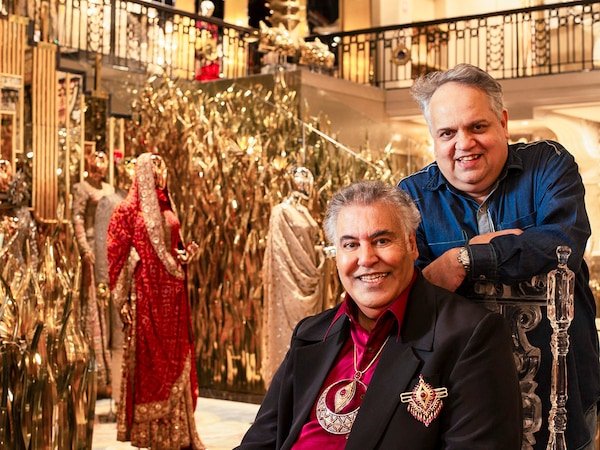
‘A Wonder Room’ sees the veteran designers venture beyond fashion to create and curate interiors, objects and artworks steeped in their signature maximalist Indian aesthetic
A floating city, suspended from the ceiling. Hundreds of miniature Gujarati windows. Jaalis that detail the nuances of Indian architecture, across from a swath of Mumbai depicted entirely in brass. Abu Jani Sandeep Khosla’s ‘Mubarak Baug’, all black, gold and sprawling over a magnificent 20,000 sq ft just off bustling Dhobi Talao in Mumbai, rewrites the rules of retail—and of the 40-year-old brand as you know it.
The new flagship store is an elaborate glimpse into ‘A Wonder Room’, a new foray that moves the veteran duo beyond clothing, even as they mark four decades in fashion. Mubarak Baug is gilded and grandiose, fantastical and fabulous, but only a precursor to the vertical, the headquarters to which will open in Goa later this year.
At Mubarak Baug, the details of the space are arresting in a way that you almost don’t notice the clothes; the Goa ‘A Wonder Room’ headquarters will be an all-out art and design gallery, with no bridal ensembles in sight.
While designers Abu Jani and Sandeep Khosla have dabbled in interiors and craft over time, the A Wonder Room vertical now gives it definitive form; through the gallery concept, the duo will create, curate and collaborate with artists to design spaces, objects and events in their signature ‘India maximal’ style.
“Everyone here is maximalist,” Khosla addresses a gathering. “Indians, by nature, don’t know how to be minimal. When was the last time you had just one item on your plate for dinner?”
In conversation with Forbes India, Sandeep Khosla spoke about reinventing the brand, creating an immersive experience in the age of online shopping, and why India’s future luxury story should be unapologetically Indian. Edited excerpts:
Q. After four decades in fashion, why launch A Wonder Room now?
The journey has been fantastical for 40 years. But every creative business reaches a point where it needs to be reborn. We wanted to reinvent and excite ourselves all over again.
Fashion remains critical for us, and we’re revisiting many aspects of our past through clothing. But A Wonder Room comes from something we’ve always loved beyond fashion: Art, objects, interiors, craftsmanship, antiques. Wherever we’ve travelled in the world, the first thing we’d look for was an antique market.
A Wonder Room is the natural extension of that journey. It’s time to let our imagination travel into every direction we’ve always wanted it to.
Q. What was the vision for the space in Mumbai? Why did you choose to restore a dilapidated building?
When we started looking for a flagship location, our brief was very clear: Find us an old cinema hall, a heritage site, something grand with extraordinary ceiling heights. In Mumbai, you’re often restricted by space.
When this property came up, it was actually a former Brand Factory outlet. Before that it was a Parsi-Gujarati theatre, and before the building existed, it formed part of the original Dhobi Talao landscape.
When we first saw it, it was honestly quite dreadful. There were cartons everywhere, aluminium staircases, dozens of brands operating inside. But Abu and I could see beyond all of that. We said, “Let’s get the space first. Then we’ll work our magic.”
That’s really where ‘A Wonder Room’ began. We wanted to create something that could stand alongside any international luxury experience while being completely made in India.
Everything here is made in India. That’s very important to us. How often do you get an opportunity to showcase Indian art and craftsmanship to the world?
We also wanted it to be more than a store. The ambition was to create an experience. Like the great fashion destinations of the world that people visit almost as museums, we wanted visitors coming to Mumbai to feel that A Wonder Room was somewhere they had to see.
Q. The interiors blend fantasy with deeply Indian references. How did that evolve?
Nostalgia played a big role. I grew up partly in Kapurthala [in Punjab], in a house called Mubarak Manzil. The word ‘Mubarak’ stayed with me because it’s such a beautiful word. We began imagining a fantastical garden, our own utopia, our own Xanadu.
At the same time, everything had to be rooted in India. The architectural references, the screens, the decorative elements, even the Art Deco influences drawn from Mumbai’s visual history.
The oversized birds floating in the clouds are pure fantasy. We wanted people to walk in and have that moment of surprise, where they think, “What exactly am I looking at?” You could love it or hate it, but it had to evoke emotion.
Q. Why the name ‘A Wonder Room’?
Years ago, a French photographer friend visited one of our homes in Goa and told us, “Every room is a wonder room.”
The phrase stayed with us.
In our homes, no two rooms look alike because there are always stories to tell. Every object matters. A carpet, a table, a painting, a vessel, everything has meaning. A Wonder Room is really an extension of how we’ve always lived.
And this won’t stop in Mumbai. We’re opening in Goa soon as well, in a large bungalow that we’re transforming into a series of immersive rooms filled with wonderment.
Q. You describe A Wonder Room as an art and design gallery, more than a retail concept. Will you be showcasing works by other artists?
Absolutely. We want to work with artisans, artists and makers across disciplines. Several creative collaborators have already contributed to this space.
Many pieces here are made from surplus fabrics and materials from our ateliers. Objects have been upcycled and reimagined. Some installations took over a year to complete. Collaboration is crucial.
Q. According to you, what does an elaborate retail experience like this offer in the age of online shopping?
Unfortunately, we have come into a time now where everything is on a downward trend of sorts. Our exposure has increased, but what we’re getting is a lot of mediocrity. People are buying things on Instagram, for instance, but you don’t really know what you’re getting. It may say ‘silk’, but is it even woven? Carpets are being machine-made in China, and it’s hard to tell the difference. Everything is losing its value, and we’re unable to support our artisans in the bargain, often unintentionally.
That is not negotiable in our lives. I understand that that’s where commerce lies, and it’s what you have to do to earn the bread. But as long we are around, we’re only interested in making the jam.
Q. You’ve long championed maximalism. Do you think India is finally embracing it again?
Maximalism is India’s natural DNA.
Look at our palaces, our textiles, our food, our celebrations. We’re inherently maximal people. But for years we’ve tried to reject that part of ourselves, often because we believed Western standards represented sophistication.
What happened instead was a generation of white walls and beige interiors that often reflected a lack of imagination rather than restraint. It’s almost laziness, the way each home is now looking just like the other. When you travel through Europe, you see people confidently using colour, texture and personality. We should have the same confidence in our own aesthetic traditions, and make that effort to make our homes say something about ourselves and the way we live.
Q. Is that also how you define Indian luxury?
Luxury is a complicated word because it has become overused. India has always been born out of luxury in a certain sense. What interests me more is authenticity. Why should someone travel to Milan to buy a sofa if an equally beautiful one can be crafted in India?
We’re not saying every home should become a palace. But why shouldn’t Indian craftsmanship appear in contemporary ways? The legs of a table could incorporate inlay work. Brass can be elegant. Indian design doesn’t need to apologise for itself.
Q. Forty years ago, what did you understand about the Indian luxury consumer that others perhaps didn’t?
We never consciously set out to understand a consumer. We designed for ourselves. We were fortunate because we started at a time when a new generation of Indian wealth was emerging. They were curious. They wanted to experiment. They were willing to support art, craft and design.
Today, sometimes we’re too driven by labels. We assume a product is superior because it comes from a Western luxury brand. But an Indian object can be every bit as sophisticated and, in many cases, even better.
Q. You’ve dressed everyone from the Bachchans to the Ambanis, and maintained close associations with celebrities over the years. How important have those relationships been for a brand like yours?
Every important relationship in our lives came through our work. Abu and I grew up with fairly well-off families, but in both our cases, our families lost that wealth along the way. What we did have was a value of culture and style ingrained in us. The people who supported us, whether the Bachchans, the Ambanis, Dimple Kapadia or many others, believed in what we were creating.
Of course, visibility helps, and the brand certainly did benefit. But ultimately, you must make a good product. If the work isn’t good, no amount of connections can sustain a brand for 40 years.
Q. How do you see your brand growing beyond the two of you?
We’re investing heavily in our teams. We’re demanding bosses because we always ask for more. But hopefully we’re passing on the values that built this brand.
I hope we’ve encouraged people to dream bigger. Whether through fashion, interiors or A Wonder Room, we’ve always believed in imagination, craftsmanship and taking risks. You need a certain amount of audacity to realise your dreams, however mad they may seem.
As long as India remains our muse, we’ll have stories left to tell.

Desk
Verified JournalistDiscover the latest startup, business, and funding news. Get insights on trends, IPOs, mergers, and acquisitions. Perfect for entrepreneurs, investors.
